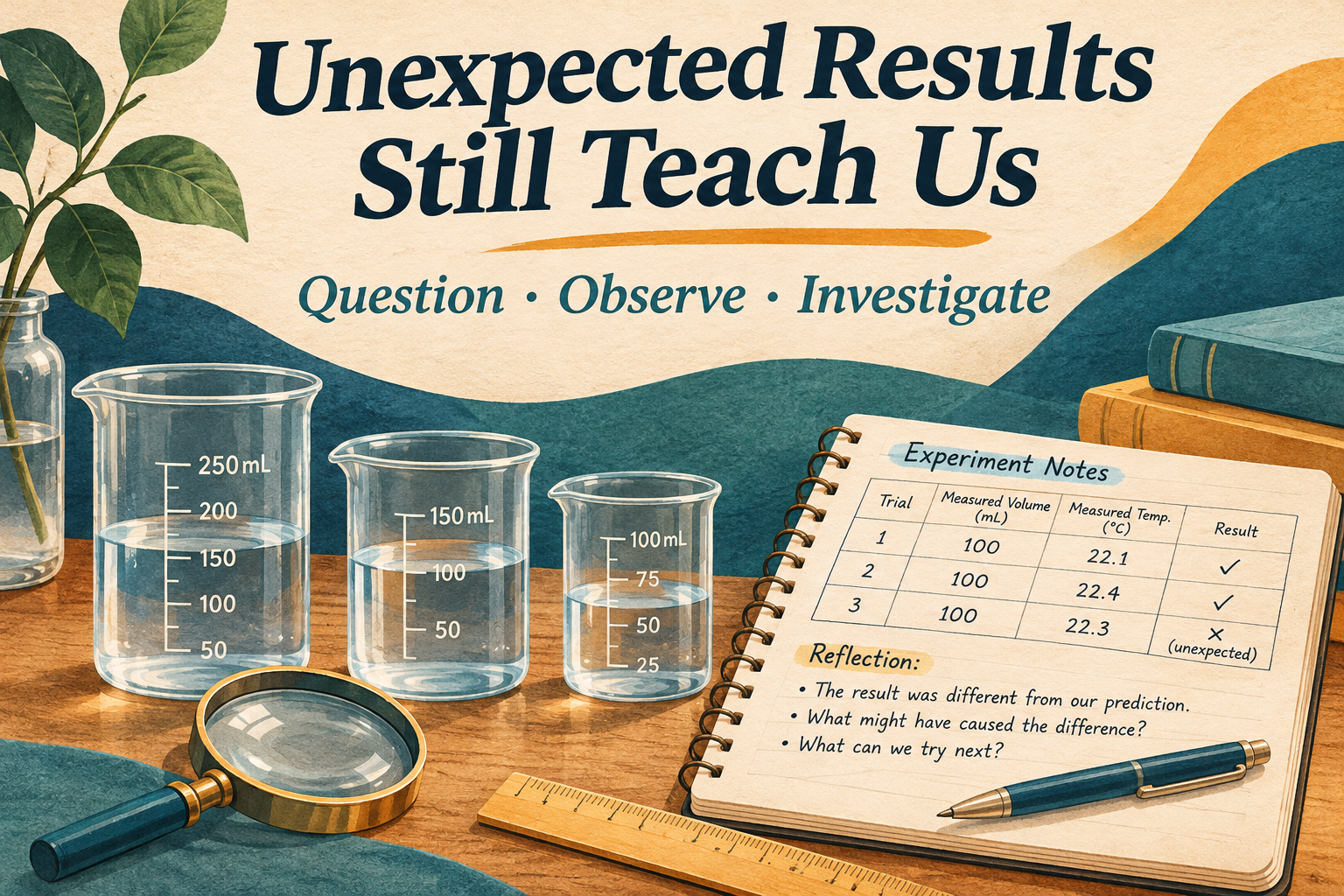
An experiment that produces an unexpected result is not necessarily a wasted learning opportunity. Honest records, closer attention to conditions and a better next question can all move understanding forward.
BC Science 10 connects questioning, prediction, investigation, analysis and evaluation. The outcome matters, but so does the reasoning used to interpret it.
01 | Separate prediction, observation and explanation
What we expected is a prediction. What we measured or saw is an observation. Why it may have happened is an explanation. Keeping these separate reduces the temptation to replace evidence with expectations. An unexpected result should not be rewritten to match a preferred answer.
02 | Return to the conditions
Ask what changed, what needed to stay consistent, whether measurement methods were comparable and whether records are complete. These questions may not identify a cause immediately, but they can narrow possibilities. Investigation must follow safety requirements and teacher guidance rather than uncontrolled repetition.
03 | State the limits of the conclusion
“In this trial we observed…” is often more defensible than “This always happens.” When evidence is limited, identify that limitation and propose the observations needed next. A useful reflection records the original question, actual observations, possible influences and a next step.
For families considering full-time high school education, these habits of inquiry and reflection help reveal the learning process beyond a single successful demonstration.
This is a general curriculum guide, not a report of an experiment conducted at a particular campus. AI-generated illustrations are conceptual, not real experimental data.
Explore full-time high school education
Explore the BC curriculum and CSEEC schools. Contact the school to learn about full-time enrolment at the relevant campus.
Source: Official information